DeFi Earn: The Aave Integration at Launch
Unitywallet 8.2.1 introduced access to supported Aave USDT markets in February 2025. The screenshots and examples describe that release. Check the current app and Helpdesk for available markets, fees and instructions before depositing.
Key Concepts to Know Before Getting Started
If you’re already familiar with DeFi concepts, feel free to skip ahead to the 'Let’s Get Started' section. Otherwise, here are a few essential terms to help you navigate DeFi Earn with confidence.
What Is Tether (USDT)?
Tether (USDT) is the most widely used stablecoin, pegged 1:1 to the US dollar. Issued by Tether Limited, it operates on multiple blockchains, offering liquidity and stability for trading, remittances, and DeFi applications.
What Is Aave?
Aave is a decentralized liquidity protocol for supplying and borrowing crypto assets through smart contracts. Suppliers earn variable interest based on market conditions. DeFi Earn provides an in-app interface to supported Aave markets; supplied assets remain subject to Aave’s smart contracts, liquidity and protocol risks.
Understanding Liquidity Pools & Earnings
Aave’s liquidity pools are smart contract-powered reserves where users deposit crypto for borrowers to access. When you deposit Tether (USDT) into an Aave pool, your funds contribute to the available liquidity.
Borrowers take loans against collateral, and depositors earn interest from the fees borrowers pay. Interest rates adjust based on supply and demand—higher borrowing leads to higher yields. This allows you to earn rewards on idle assets without actively managing trades.
Liquidity Pools vs. Staking: Key Differences
Liquidity Pools: You supply assets to a pool used by borrowers and earn variable interest. Aave withdrawals depend on the pool’s available, unborrowed liquidity. If a position also secures a loan, collateral requirements can restrict withdrawals. Immediate withdrawal is not guaranteed.
Staking: Involves locking tokens to support blockchain operations (e.g., transaction validation in proof-of-stake networks). Rewards come from the network, usually in newly minted tokens.
What Are Aave aTokens?
When assets are supplied to an Aave V3 market, interest-bearing aTokens represent the supplied amount and accrued yield. On withdrawal, the corresponding aTokens are burned and the underlying asset is returned, subject to the protocol’s conditions. An aToken is not a cross-chain wrapper created to move USDT to another blockchain.
Why Choose Unitywallet’s DeFi Earn?
• Variable Yield: Earn interest through Aave, with no guaranteed rate or return.
• Displayed APYs: Review the current estimated annualized rate before depositing; it can change.
• Multi-Chain Support: Choose from the eligible assets and networks currently available in the app.
• In-App Aave Access: Interact with supported Aave markets through Unitywallet.
• Self-Custodial Access: You control your wallet keys; deposited assets are governed by Aave’s smart contracts and withdrawal rules.
Let’s Get Started
To use DeFi Earn, deposit Tether (USDT) into your Unitywallet or swap another asset into USDT with the green DeFi Earn badge. If you don’t see the badge, check the notes below.
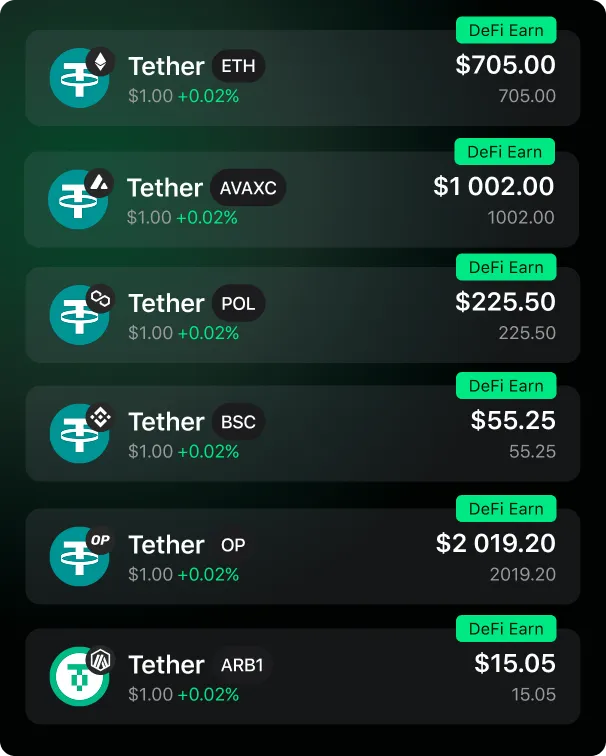
For current supported assets, networks and instructions, see the Unitywallet Helpdesk. At the February 2025 launch, the USDT guide listed these six networks:
Ethereum (ETH), Avalanche C-Chain (AVAXC), Polygon (POL), Binance Smart Chain (BSC), Optimism (OP), and Arbitrum One (ARB1).
Important Notes Before You Begin:
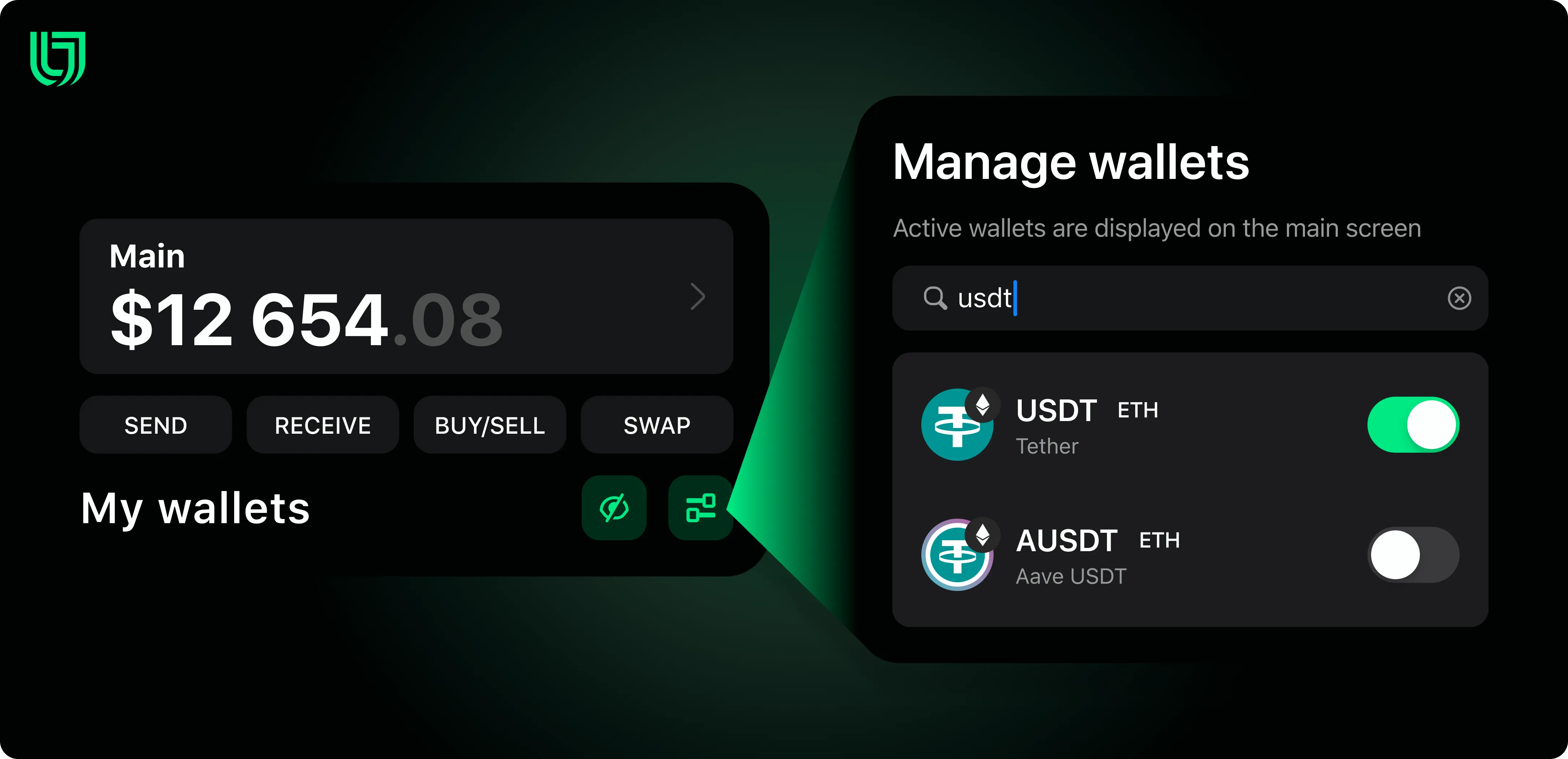
Enable USDT Wallet: If the supported Tether (USDT) variants don’t appear under 'My Wallets', tap the toggle switch (see image below) to activate them.
Manage Wallets: In the 'Manage Wallets' page, search for 'Tether' or 'USDT' and toggle the switch for the variant you want to use.
DeFi Earn Badge: Once added, your DeFi Earn badge should appear. If not, check the additional notes below.
Activate Aave Variants: Enable the Aave USDT variant for the blockchain you plan to use. For example, if earning on Tether USDT (ETH), also activate Aave USDT (ETH). If you forget, you’ll be prompted during the DeFi Earn process.
Network/Gas Fees: Most blockchains require gas fees for transactions. Ensure you have the native token for the blockchain you’re using (e.g., ETH for Ethereum, BNB for Binance Smart Chain, POL for Polygon, etc.) available in your wallet to cover these fees.
Availability: Access depends on your location and the terms currently applicable to the service. Check eligibility in the app before depositing; the country list in the original release announcement is not a current eligibility guide.
What Happens Next & What Will I Earn?
When a DeFi Earn deposit succeeds, the selected assets are supplied to the corresponding Aave market on the chosen network. Interest accrues at a variable rate; the displayed APY is an annualized estimate, not a fixed or guaranteed return. Network gas is normally paid in the network’s native token, separately from the supplied USDT. Review all applicable fees on the confirmation screen.
The graphic below is an illustration from the February 2025 release. Its asset labels, APYs and fee estimates are historical examples, not current terms or quotes.
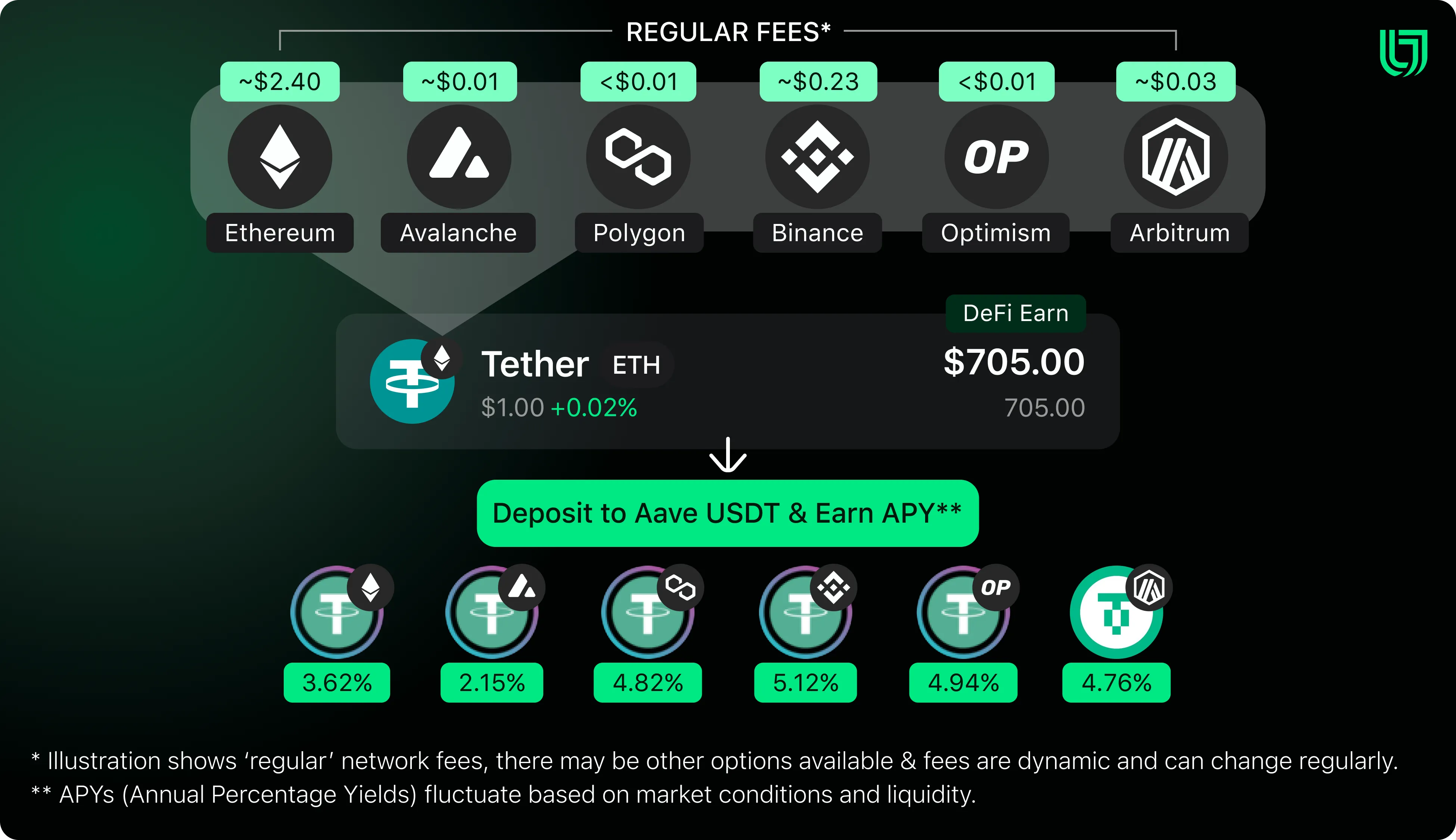
Illustrative Example from February 2025
The original illustration used a $705.00 Tether (POL) position. The figures below explain that historical example and are not a current fee quote:
The illustration assumed a $3.50 Unitywallet fee and approximately $0.01 in network costs. Actual fees are shown before confirmation; network gas is normally paid separately in the network’s native token.
The final supplied amount depends on the fees shown in the app and which asset is used to pay each fee. Check the confirmation screen rather than relying on this historical balance.
The example showed a 4.82% APY. This was an illustrative annualized rate, not a promise of future earnings or the rate available today.
You can request a withdrawal, subject to available pool liquidity, applicable collateral requirements and network conditions.
If you’re interested in understanding how APYs are calculated, check out these helpful articles:
James Chen: What Is APY and How Is It Calculated?
Chase: How To Calculate APY?
Fidelity: What Is APY and How Is It Calculated?
Using the Current DeFi Earn Guide
DeFi Earn provides access to eligible Aave markets through Unitywallet. Before using it, review the current asset and network, estimated APY, fees, available liquidity and protocol risks.
Explore the current DeFi Earn options in the app and check the Unitywallet Helpdesk before proceeding.
Disclaimer: APYs fluctuate based on market conditions. DeFi involves risks—ensure you understand them before participating. Network (gas) fees vary by blockchain and are beyond Unitywallet’s control.
The release screenshots and numerical examples are historical. Check the current Aave market and Unitywallet interface for rates, withdrawal conditions and fees.
Sources: Aave withdrawal conditions; Aave tokenization; Unitywallet Helpdesk